“Mars” from The Planets – Gustav Holst
Danse macabre, op.40 – Camille Saint-Saens
Mythics: A Suite for Orchestra – Simon Kuhn (world premiere)
Movements from Pictures at an Exhibition – Modest Mussorgsky, arr. Maurice Ravel
“Peer Gynt Suite” No.1 – Edvard Grieg
Symphonie Fantastique – Hector Berlioz

Dear Friends,
On behalf of the Board of Directors, it is my distinct pleasure to welcome you to our new season, “Symphony and Screen” – featuring music from movies, television, and video games! We are incredibly proud to support a group of extraordinary musicians whose passion brings music to life and lifts the spirits at every performance under the inspired leadership of Michael Repper, Music Director and Conductor. Our Executive Director, Martha Buckner, continues to provide innovative opportunities, such as the ASO Fan Club, that support the development of young musicians throughout Ashland County and beyond.
At its heart, music is inspiring. Together, our musicians, conductor, executive director and dedicated board work collaboratively to deliver experiences that unite, educate, and enrich our community. None of this would be possible without your continued presence and generosity. Thank you for sharing these moments with us.
Enjoy the performances!
Deborah Sullivan
President, Board of Directors

Dear Friends,
Welcome to the Ashland Symphony Orchestra’s 2026–2027 season!
It is a privilege to continue making music with you and for you as we embark on another year of inspiring performances, shared experiences, and artistic discovery. The Ashland Symphony Orchestra has always been about more than concerts. Our goal is to bring people together through the power of live music, creating moments that move us, challenge us, and remind us of our shared humanity.
This season celebrates the many ways music connects us: across generations, across cultures, and across time. From beloved masterworks to exciting new voices, our programs invite you to experience a rich tapestry of musical expression. Along the way, you’ll encounter stories of triumph and reflection, joy and resilience, and the boundless creativity that has made orchestral music such an enduring art form.
We are also proud to continue building partnerships throughout our community, creating opportunities for audiences to engage with music in new and meaningful ways. Whether through innovative collaborations, educational initiatives, or special events that bring people together beyond the concert hall, we remain committed to making the Ashland Symphony Orchestra a vibrant cultural resource for our region.
Whether you are a longtime subscriber or joining us for the first time, thank you for being part of our musical family. Your enthusiasm, support, and presence make everything we do possible.
I look forward to sharing this season with you and to experiencing the excitement of live music together.
With warmest regards,
Michael Repper

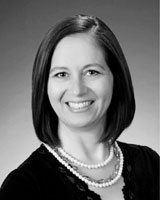
Executive Director’s Message
Fun fact: in the US, most home appliances hum a B-flat. Why? Power in the United States and Canada cycles at a frequency of 60 Hertz (Hz), meaning the electrical current changes direction 60 times every second. This pulsating current causes metal parts and transformers inside appliances to vibrate through a process called magnetostriction. A frequency of 60 Hz (or its 120 Hz harmonic) creates an audible sound wave that matches closely with a musical B-flat.
Why did we pick a musical theme of Symphony and Screen for this epic concert season?
Just like a film score, music makes up the fabric of our lives. As you listen to our worldclass musicians, consider…
Music communicates what is unspoken.
Music tells us the “mood”.
Music foreshadows.
Music tells us what the world sounds like.
Not everything we will perform is directly related to a moment on a screen, but with a little imagination, and a lot of excitement, you will experience the music of the Ashland Symphony Orchestra as the soundtrack to your life.
Happy listening!
Martha Buckner, Executive Director

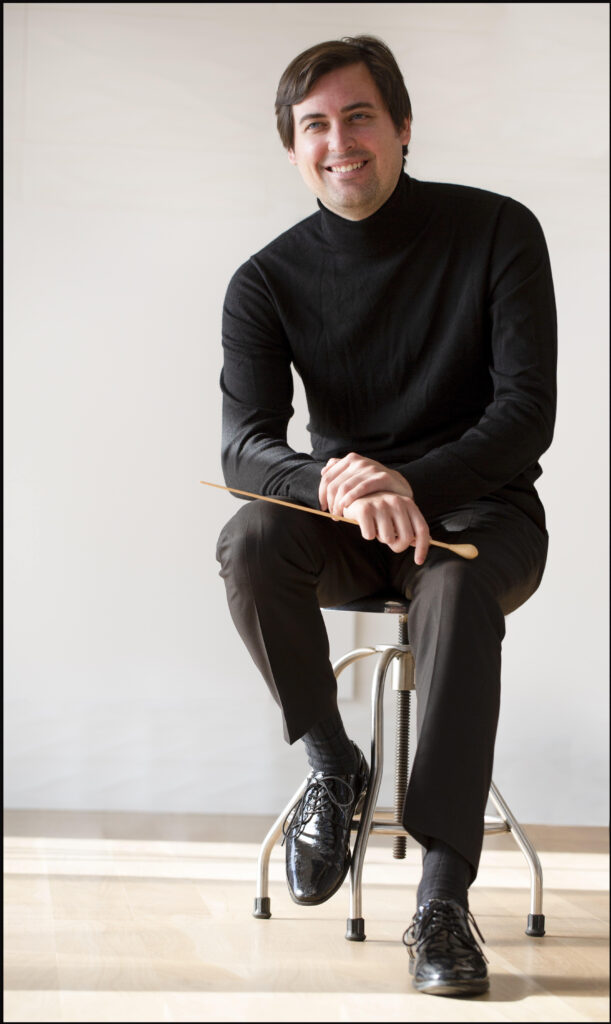
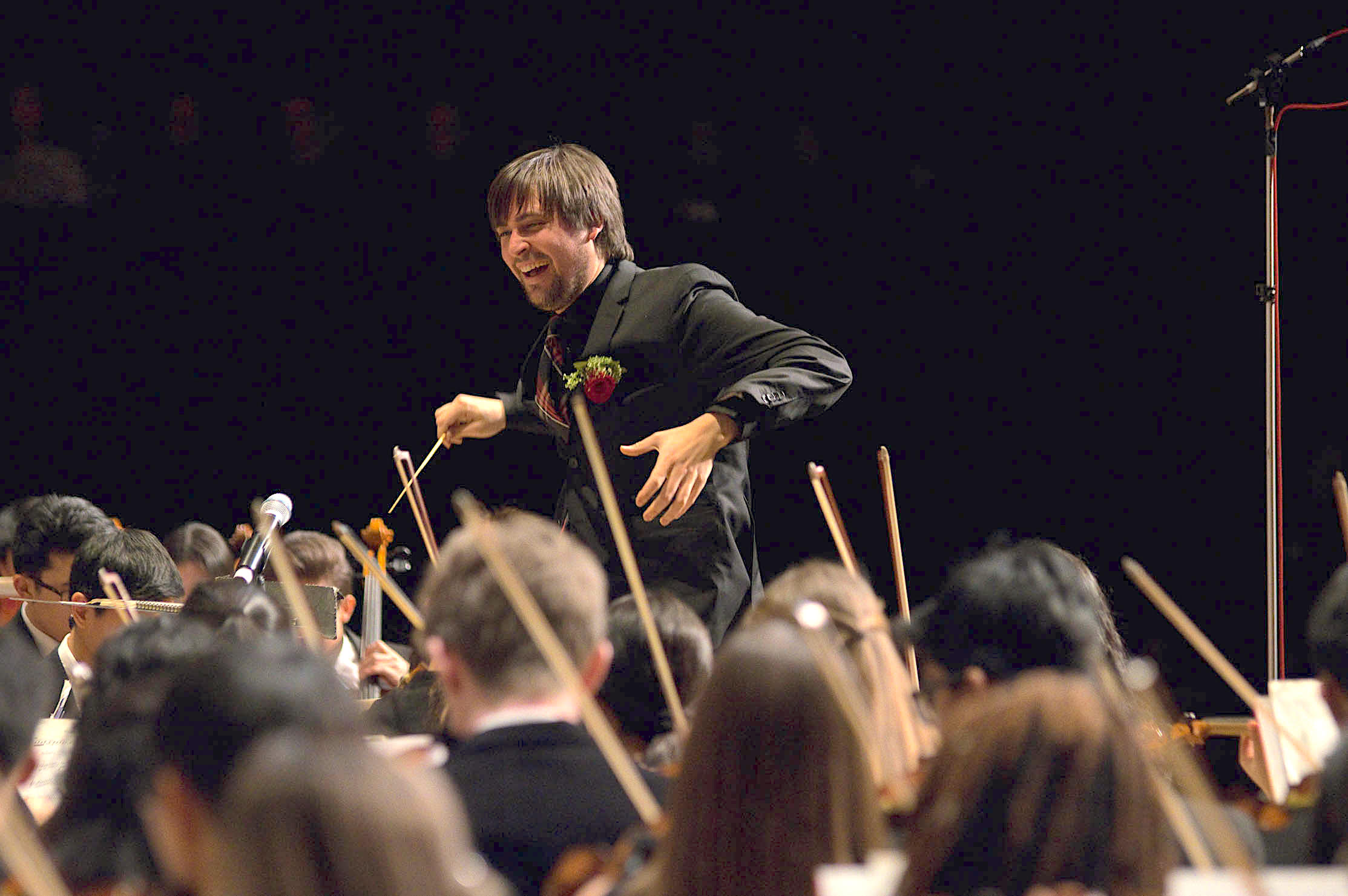
Conductor Michael Repper’s work spans six continents. In 2023, he became the youngest North American conductor to win a Grammy® Award in Best Orchestral Performance. He has an international reputation for engaging and exciting audiences of all spectrums, and for promoting new and diverse musical talents.
Repper is currently the Music Director of the Ashland Symphony Orchestra, Mid-Atlantic Symphony Orchestra, and the Northern Neck Orchestra of Virginia. He recently concluded tenures as Music Director of the New York Youth Symphony at Carnegie Hall, and as Principal Conductor of Sinfonía por el Perú, the elite youth orchestras and choruses of one of South America’s most versatile social impact music programs. Repper was the Baltimore Symphony Orchestra Conducting Fellow for two seasons, and he served as the BSO’s New Music Consultant. Recognizing his success at these ensembles, and his growing profile as a guest conductor all over the world, Repper was awarded a Solti Foundation US Career Assistance Award in 2020, 2021, 2022, and 2023.
His album with the New York Youth Symphony, which features debut recordings of works by Florence Price, Jessie Montgomery, and Valerie Coleman, achieved widespread critical acclaim, reached #1 on the Billboard Chart, and won a Grammy® Award, marking the first time a youth orchestra achieved this milestone.
Repper has collaborated on large-scale productions of symphonic and theatrical works with the Weill Music Institute at Carnegie Hall, the Chicago Symphony Orchestra, Ravinia Festival, Peabody Institute of Music, and the New School of Music, among others. An avid pianist, he regularly performs as a soloist alongside his orchestras.
Alongside the standard repertoire, Repper is especially invested in programming new music and showcasing fresh talent. His ensembles have performed dozens of world premieres and pursued innovative commissions, as well as a variety of Carnegie Hall premieres from established and emerging composers.
His experience with choruses has been recognized with significant positions, including his tenure as the Music Director at the Baltimore Basilica, the first Catholic Cathedral in the United States. Internationally, Repper has performed with highly regarded ensembles and in the world’s greatest venues, including the São Paulo Symphony, and at the Palau de la Musica in Barcelona, Carnegie Hall, and others.
His discography includes the aforementioned album of music with the New York Youth Symphony, alongside an album with the Grammy®-Nominated Metropolis Ensemble and Grammy®-Winning Brooklyn Youth Chorus (“Musical America”), and several with the Peabody Institute as an Assistant Conductor. With the New York Youth Symphony during the Coronavirus pandemic, he was one of the first to pioneer the practice of distanced orchestral performance videos, and he made two performance appearances on CNN, the final one with Platinum-Artist Billy Ray Cyrus.
Repper complements his work with professional orchestras with a firm commitment to education, and travels worldwide to work with ensembles of young musicians. As Artistic Director of the Chamber Music Society of Maryland, he ushered in a slate of innovative educational programming, such as the Reinecke Youth Chamber Music Scholarship and Fellowship Program. He has conducted several masterclasses for orchestras from all over the United States on behalf of the New York Philharmonic, and conducts side-by-side and educational concerts with major orchestras, including the Baltimore Symphony, the Colorado Symphony, and the Sarasota Orchestra.
Repper’s most influential conducting mentors are Marin Alsop and the late Gustav Meier. He believes that a conductor’s main role is to connect people and to use performance as a vehicle for positive change. He aims to promote a diverse and inclusive future for the arts, and to pay forward the passion for community that his mentors demonstrated to him.
Gustav HOLST [b Cheltenham, 21 Sept 1874; d London, 25 May 1934. English]
THE PLANETS: Mars, the Bringer of War <1914-1916>
Instrumentation: flutes, piccolo, oboe, English horn, clarinets, bassoons, horns, trumpets, trombones, tuba, timpani, percussion, and strings
Duration: 6 minutes
Gustav Holst is one of England’s most revered composers, creator of musical works in great variety: choral music, songs, band music, orchestral works, ballet, and more. His musical purview was remarkably diverse, and his compositions are frequently performed and appreciated in Great Britain. His popularity there bears comparison with his good friend and follow composer, Ralph Vaughan Williams. In this country, the matter is somewhat different. His reputation rests largely, and solidly, upon his two immortal works for band, Suites No. 1 and No. 2 for Military Band. It is hard, indeed, to participate in American public school music band programs without having performed one or both of these classics. They simply stand at the top of the repertoire for band, and almost every American band student knows them well. On the other hand, those who frequent professional orchestra concerts in this country largely know Holst through his most popular orchestral work, The Planets.
Born of Scandinavian descent in rural England to a musical, middle-class family, Holst received a musical education early, playing the violin and piano, and later taking up the trombone, the mastery of which his father thought would help his asthma. Holst worked for a while as village organist and choirmaster before attending the Royal College of Music, where he met his life-long friend Vaughan Williams. He eventually focused on the trombone and earned a modest living early on as a member of various orchestras. He soon gave that life up and spent the rest of his life teaching music in private girls’ schools.
The musical life of Great Britain in those days was strongly influenced by a new appreciation and re-examination of the native musical treasures of the sixteenth and seventeenth centuries, as well as a fascination with traditional English folk tunes—these influences were significant in the lives of both composers. Of course, he was aware of the major compositions of contemporary composers like Stravinsky, Schoenberg, Ravel, and Richard Strauss, and these figured in his artistic development. Two rather unusual, but important influences in his life and works were Hindu religion and philosophy, and astrology. His abiding interest in Hindu texts began early in the century, leading him to engage in the formal study of Sanskrit–translating the texts for himself–and to compose several of his important works on those texts, including two operas. His association with astrology began during a trip to Spain in 1912, when a friend of his inspired the interest, and Holst maintained an interest in the subject—reading fortunes along the way–for the rest of his life.
It is that interest in astrology—not astronomy—that is central to his composition of The Planets. Holst began the work in 1913and completed it in 1917. The first performance was given privately in 1918, and word of mouth raised public expectations for the first public performance in 1920. Originally entitled Seven Pieces for Large Orchestra, the suite suggests to many, his familiarity with Schoenberg’s similar use of the phrase. Others see inspiration derived from Mussorgsky’s Pictures at an Exhibition or Elgar’s Enigma Variations. Holst’s pictorialism is less specific than these antecedents, but spectacularly vivid, nonetheless. Indeed, composed for a large orchestra—remember, large—and perhaps more importantly—varied orchestras were all the rage in the late romantic era, with the orchestras of Richard Strauss, Mahler, and Stravinsky, among others, as models. In addition to the usual full orchestra, Holst’s score calls for woodwinds in fours–including at times, alto flute, two piccolos, and the (really) rare bass oboe. The brass section features six horns, four trumpets, and, in addition to the standard bass tuba, a smaller, tenor tuba. There is an organ and a celesta, and for the final movement, a wordless women’s chorus—à la Debussy. [The Ashland Symphony Orchestra will be performing this evening with a reduced orchestra.]
The order and number of the seven movements has generated much discussion with regard to the actual planets and their number and position. It’s all irrelevant, for Holst’s work has to do with the astrological signs—of which there are seven–and not with how we define what planets are, or their respective positions with relation to the sun, even what conditions may or may not be on them. So, the order of movements, beginning with Mars, stems from the astrological succession.
Holst chose the relatively unusual time signature of five-four time for this ominous evocation of war, beginning with a hypnotic rhythm, repeated over and over, as chords constantly grow and threaten, until they are practically howling. Following a reiteration of the driving, repeated rhythm in the strings, the rarely used small, or tenor tuba, is featured along with the trumpets in punchy fanfares. This is the original Darth Vader and the Death Star music! The dreary, desolate landscape of destruction in war is admirably depicted in a bleak, slower middle section before a repeat of the opening hammering material. This gripping—no glory here!–evocation of war ends with dramatic, blunt hammer strokes, separated by pauses that leave no doubt of the utter destruction and obliteration of war.
–Wm. E. Runyan
©William E. Runyan
Camille SAINT-SAËNS [b Paris, 9 Oct 1835; d Algiers, 16 Dec 1921. French]
Danse macabre, op.40 <1874>
Instrumentation: flutes, piccolo, oboes, clarinets, bassoons, horns, trumpets, trombones, tuba, timpani, percussion, and strings
Duration: 8 minutes
Camille Saint-Saëns lived a long life and was remarkable for his wide-ranging intellectual interests and abilities. As a child he was, of course, a precocious musical talent, but even then, he evinced a strong natural interest in almost every academic subject–including, but certainly not restricted to, astronomy, archaeology, mathematics, religion, Latin, and Greek. In addition to a life of musical composition and virtuoso keyboard performance, he also enjoyed success as a music journalist, champion of early music (Handel and Bach), and leadership in encouraging French musical tradition. His father died when he was an infant, and he grew into middle age extraordinarily devoted to his mother–his marriage at the age of forty to a nineteen-year old did not last long. He simply left the house one day in 1881 and chose never to see her again; she died in 1950 at the age of ninety-five. Saint-Saëns went on to live an active life, filling an important role in the musical life of France–as performer, composer, author, spokesman, and scholar. He was peripatetic–researching Handel manuscripts in London, conducting concerts in Chicago and Philadelphia, visiting Uruguay and writing a hymn for their national holiday, and vacationing in the Canary Islands. He celebrated seventy-five years of concertizing in August of 1921 in his eighty-sixth year and died a few months later.
The danse macabre, or “dance of death,” is one of the most common themes in European art, literature, and music since the Middle Ages. The fourteenth century was an especially rough one, the “Black Death” alone killing perhaps two hundred million people in Europe—not to mention the Hundred Year’s War and various famines. In the face of almost certain, widespread, and early death, there arose the allegory of death dancing with everyone, regardless of station. The allegory appears in countless frescos, murals, and paintings in churches, is a common theme in drama, and the subject of woodcuts in early publications. The ubiquity of death is matched by an almost obsessive preoccupation in artistic representation. The most common imagery is that of death as a skeleton, dancing with a procession of souls that represent all of society: the Pope, emperors, the rich, the poor, beggars, children—everyone leveled by their common end. An end that was certain, probably soon, and thus should be prepared for. That allegory is still with us as a common cultural artifact, and surfaces everywhere in the art of our time.
The Romantics of the nineteenth century could not resist the historical, gloomy allusion, and composers from Berlioz, Liszt, and a host of others wove it into their compositions. Saint-Saëns, while perhaps most comfortable with more abstract music, nevertheless was an equal master of telling “stories” in music. So, in the 1870s, influenced by the early innovator in “tone poems,” Franz Liszt, he composed four of his own. His Danse macabre from 1874 for orchestra is a re-working of a song that he had composed two years earlier with a text that vividly describes the figure of death scraping on his violin at midnight, cold winds blowing, as dancers leap, their bones “cracking.”
He recast the vocal part as a solo violin, accompanied by an orchestra that includes the xylophone—a perfect allusion to rattling bones. The solo harp opens with twelve sonorous notes depicting the stroke of midnight, followed by the entrance of the solo “fiddle” of death. Saint-Saëns masterfully evokes the “scratchy,” sinister fiddle by calling for the instrument to be re-tuned by lowering the top E string to an Eb—thus giving the famous diabolus in musica (devil in music), or tritone, the fundamental dissonance in both harmony and melody. Two themes are heard: one in the solo flute, and the second a descending scale in the solo violin. They furnish the basic ideas of the piece. After a short fugal section, the famous Dies iræ (day of wrath) from the chant in the Roman Catholic Requiem Mass is heard staccato in the woodwinds. This ominous theme appears in a wealth of compositions, perhaps most famously in Berlioz’ Symphonie fantastique, but everywhere, from Haydn to John Williams’ Star Wars. The ghastly dance continues, but eventually ends at dawn, heralded by a solo oboe depicting the cock’s crow. The solo violin, now less ominous, and more consoling plays a short elegy, and the skeletons return to their graves–the rest live for another day. Halloween is over.
–Wm. E. Runyan
© 2017 William E. Runyan
Simon KUHN [b Shelby, 5 Sept 2008. American]
Mythics: A Suite for Orchestra [World Premiere]
I. Faerie
II.Ouroboros
III. Gorynych
IV. Azrael
V. Ares
Instrumentation: flutes, oboes, clarinets, bassoons, horns, trumpets, trombones, tuba, timpani, percussion, and strings
Duration: 7 minutes
Mythics is a five-movement piece depicting different beasts, creatures, or deities from mythology. This programmatic work, inspired by the likes of Gustav Holst and Modest Mussorgsky takes the listener on an epic journey.
Faerie. A slow, beautiful selection that captures the songs of faeries and nymphs. It places a spotlight on the woodwind and string sections while accompanied by the low brass.
Ouroboro. Exudes mystery through a strong ostinato that represents the eternal cycle of life and death of the ancient Egyptians.
Gorynych. The Zmey Gorynych of Slavic Folklore rudely interrupts Ouroboros with short yet exciting movement. The Gorynych is a fire-breathing, multi-headed serpent. This dragon-like creature creates chaos featuring frantic strings and powerful, dissonant brass chords.
Azrael. The angel of death and psychopomp brings an eerie calm to transport the souls of the deceased. The orchestra represents this through odd time signatures and a motif that is funeral-like in nature.
Ares. This final movement depicts the ancient Greek god of war through a militaristic march which represents the glory people find mixed with jarring, unrelenting beats that represent the true nature of war.
Mythics paints an epic picture of various and powerful creatures from across different legends. It allows the listener to travel on a journey through the myths of old.
Simon Kuhn is in his senior year at Ashland High School. He is an accomplished performer on both the bass and French horn in various ensembles throughout the district. Kuhn’s love for composing and performing started at a young age and has continued through his high school career. Kuhn was selected for early entry into the Ohio Army National Guard and is currently enlisted with the rank of Private. His future plans include earning his music degree to continue his composing and performing, as well as officer candidate school following university graduation.
Modest MUSSORGSKY [b Karevo, Pskov district, 9/21 March 1839; d St Petersburg, 16/28 March 1881. Russian]
Orchestration by Maurice RAVEL
Pictures at an Exhibition <1874>
VIII. Catacombs/Cum mortis in lingua mortua
IX. The Hut on Fowl’s Legs (Baba Yaga)
X. The Great Gate of Kiev
Instrumentation: flutes, piccolo, oboe, English horn, clarinets, bassoons, horns, trumpets, trombones, tuba, timpani, percussion, and strings
Duration: 13 minutes
A staple of piano recitals given by virtuosi, this work is probably more familiar to many in its orchestration by Ravel. Unquestionably, a tour de force for the solo pianist is equally a sound spectacular for the modern orchestra. It lends itself admirably to reinterpretation in the orchestral idiom for the simple reason that few works in the repertoire consist of such deliberate and vivid depictions of a variety of colorful images from the physical realm. It was composed by Mussorgsky in 1874 during three weeks in June as a tribute to the distinguished Russian architect and artist, Viktor Hartmann, who had unexpectedly died of an aneurysm at the age of 39. Hartmann, a Volga German, was one of the champions of a new resurgence of indigenous Russian art, along with his close friend Mussorgsky. In recognition of Hartmann’s work, an exhibition of some 400 of his drawings and paintings was given in the Academy of Fine Arts in St Petersburg in February and March of 1874. Mussorgsky’s musical tribute to his friend takes the form of a suite of movements that vividly depict the subjects of ten of the paintings (few of the art works survive).
Pictures at an Exhibition is so replete with such a variety of colorful, eccentric and unique visual references that it almost begged for a setting for orchestra, with that group’s magnificent palette of sound “colors.” Yet, in all fairness it must be said that it is unquestionably equally successful as a solo piano work—imagine one person drawing all of the color, drama and power out of one instrument! To my mind, a comparison between the original piano version and its orchestration is rather like imagining a Western vista photographed in black and white by Ansel Adams on the one hand, and the same vista painted on a grand scale by Alfred Bierstadt. Both would be equally stunning interpretations. In any case, Mussorgsky’s work was almost immediately seized upon by orchestrators, and literally dozens of orchestral interpretations have been pumped out during the past 135 years—many by distinguished familiar conductors, composers, and orchestrators. Some of these occasionally are performed today, but only one has achieved almost universal acclaim and dominates today’s concert performances, and that is the one done by Maurice Ravel in 1922. His gift for orchestration is well familiar to audiences, and his choices in the orchestration now define the work in the world’s imagination.
… leads us to the dark and moribund world of the Roman catacombs, subtitled “With the dead, in a dead language.”
Massive low brass and French horn passages ominously begin the first section, later joined by the trumpets in a powerful evocation of the finality of death. The second section is somewhat less foreboding, with strings and woodwinds creating a somewhat reflective search for the meaning of it all. The next movement takes the concept of “bizarre” to a truly higher level: it pictures the famous Slavic witch, Baba Yaga, who eats small children and lives in a hut standing on chicken legs. This particular hut is in the shape of a clock whose bells enter into the texture. It’s a grotesque exercise in frenetic chasing around, far exceeding what we have heard so far. The end winds up in a whirlwind that spins right into the finale of the whole suite, the “Great Gate of Kiev.” The majestic theme is worked through in several versions—some with intimations of a carillon. Each version seems to be more intense than the one before, with teasing sections of calmness, only to be redoubled by even more massive and imposing renditions that seem to challenge human and musical limitations. The peroration is usually considered to be just about the loudest and most imposing playing of which an orchestra is capable. Enjoy!
–Wm. E. Runyan
© 2015 William E. Runyan
Edvard GRIEG [b Bergen, 15 June 1843; d Bergen, 4 Sept 1907. Norwegian]
Peer Gynt: Suite No.1, op.46 <1874-1875; rev. 1885>
Morning (Morgenstemning)
Ase’s Death (Åses død)
Anitra’s Dance (Anitras dans)
In the Hall of the Mountain King (I dovregubbens hall)
Instrumentation: flutes, piccolo, oboes, clarinets, bassoons, horns, trumpets, trombones, tuba, timpani, percussion, and strings
Duration: 15 minutes
Edvard Grieg was the most significant Scandinavian composer during the years leading up to the beginning of the twentieth century. He was a prolific composer of songs and music for the piano; small lyric compositions being his obvious forte. In addition to his songs, he wrote a large number of choral works, many for unaccompanied male voices, and some of them remain evergreen favorites. While he did compose in other genres, achieving notable success with his only piano concerto and his string quartet, the latter were exceptional. He was educated at the Leipzig Conservatory, where his early models were Schubert and Schumann, and he spent a lot of time in Copenhagen. Like all of his fellow countrymen of that generation, he was oriented to Denmark, the Danish language, and Danish culture in general. Later, in his early twenties, under the influence of the great Norwegian violinist, Ole Bull, he developed an affinity for Norwegian peasant culture. That effected a major change in his musical outlook, and for the rest of his life he plumbed the depths of Norwegian folk music and literature. It became a major part of his musical style and placed him firmly in the ranks of the nationalist composers so characteristic of the latter half of the nineteenth century. Even when not directly quoting folk materials, the harmonies, rhythms, and melodic nuances of that tradition deeply inform his musical style.
In 1874 Grieg was asked to write incidental music for Henrik Ibsen’s 1867 play, Peer Gynt. Initially, Grieg thought that it would be a short and easily completed project, but it stretched into some twenty-six separate pieces, which he completed by July 1875. Later, the composer extracted eight of these movements to comprise two, four-movement suites. The play and the music premiered in 1976, but the play, a rather strange and almost bizarre affair, has not garnered the success of Grieg’s music. While the average listener probably conjures up visions of Nordic vistas and quaint, folkish sagas, that is not what the picaresque play and Grieg’s atmospheric music is about. Rather, it tracks an improbable and less-than-sympathetic rogue in a variety of adventures in places like Egypt and Morocco. The ubiquitous “morning” scene takes place in the Arabian desert, where our hero awakens after having been robbed by the seductress, Anitra. Anitra’s dance is that of the daughter of an Arabian chieftain, whom Gynt attempts unsuccessfully to seduce; Grieg weaves a wonderfully oriental atmosphere for her tantalizing charms. “Solveig’s Song” is from the last act of the play, where Gynt’s beloved sings of her steadfast faithfulness during his absence, even to her old age, not knowing whether he is alive or not. Originally, it was sung in the play, but here is played by the solo violin. The “Hall of the Mountain King” is a depiction of a ridiculous scene that takes place after Gynt has gotten smashing drunk with three dairymaids who were waiting to be courted by trolls. In the ensuing hangover he knocks himself out accidentally and dreams that he is challenged by the troll king over a paternity question. The music cleverly depicts Gynt’s escape after having witnessed the dance of the pig-faced trolls, and his subsequent insult to the troll king’s daughter. Grieg’s “incidental music” for the play is evocative of his mastery of the short character piece, and one can understand why it has met the test of time far better than Ibsen’s wild morality tale.
–Wm. E. Runyan
© 2015 William E. Runyan
Hector BERLIOZ [b La Cote-Saint-Andre, Isere, 11 Dec 1803; d Paris, 8 March 1869. French]
Symphonie fantastique, op.14 (Fantastic Symphony) <1830>
IV. Marche au supplice (March to the Scaffold)
V. Songe d’une nuit du sabbat (Dream of the Witches’ Sabbath)
Instrumentation: flutes, piccolo, oboes, clarinets, bassoons, horns, trumpets, trombones, tuba, timpani, percussion, and strings
Duration: 15 minutes
Of all of the major composers of the nineteenth century, Hector Berlioz is perhaps the most personally interesting. What a vivacious, unique individual he was, both in his life and in his music. And, perhaps most refreshing–for one who lived such an intense and varied existence—he was a relatively normal individual. He was single minded of purpose and impassioned in his pursuit of the composition of music that reflected his literary interests, his interaction with his physical surroundings, and his deeply felt emotions. He was not a virtuoso performer (he did play the flute and the guitar passably); his early musical training having been derived largely from the study of harmony books. However—and it is a major informing aspect of his intellect—he was a man of literature. He read widely and with sophistication from an early age and later became one of the most important music critics and general authors in music of all time.
The son of a doctor, who pressed him to follow the family tradition, Berlioz studied medicine for two years at Paris’ famed medical schools but left in disgust at the “hands on” necessities—especially the malodorous dissection labs. He pursued music, instead, finally enrolling at the Conservatory for some formal instruction. He was criticized relentlessly for much of his career, not only for his forging ahead in a progressive romantic style—violating almost every canon of composition with alacrity—but especially for his putative lack of education and traditional skills. He was undeterred.
He composed assiduously in his twenties, primarily in various genres of accompanied vocal music, before finally winning the prestigious Prix de Rome in 1830 (after several unsuccessful attempts). In the interim, two significant events occurred in his life: he encountered Beethoven’s symphonies—which opened his eyes to the expressive capabilities of instrumental music—and he saw a performance of the Anglo-Irish actress, Harriet Smithson, in a performance of Shakespeare’s Hamlet. To say that he was smitten would be one of the world’s great understatements—he was captivated, stunned, enraptured, obsessed! In a word, it was completely the stereotypical infatuation of the Romantic Era.
The result was his composition of one of music’s unique works, the Symphonie fantastique, a work without precedent, and certainly one of controversy—to this day. Where to start? It had a controversial “program,” or story, an unusual structure, odd chord progressions, unconventional melodies, and a mastery of the orchestra and orchestration that was almost unprecedented. It is cast in five movements, a bit unusual, but certainly not unique, but the notoriety is founded in the rather detailed story which is associated with the work—so detailed that it was printed and handed out to the audience at the first performance. Despite its subject matter, it wasn’t really that outré for French audiences of the time, for the public in Paris loved lurid tales in their opera librettos. Berlioz subsequently altered some of its details and published many reflections about the story and its relationship to the music, but the close association of the tale with the symphony is still considered essential. It takes us through each of the colorful movements with a detailed explanation of what the composer was thinking as he composed, or at the least, his mood. So, let’s begin.
The fireworks begin in the fourth movement (March to the Scaffold). The poet has dreamed (too much opium) that he has killed his beloved, is condemned to death, and is being marched to the scaffold for beheading. The movement tramps along, variously brilliant or softly ominous. A tumultuous arrival at the place of execution is suddenly interrupted by a soft, dreamy thought of the beloved—represented by the idée fixe played gently by the unaccompanied solo clarinet. Without warning the blade drops, the head falls, and a blaring fanfare in the winds and percussion announces the poet’s demise—or was it just a bad drug?
The gloves come off in the last movement (Dream of a Witches’ Sabbath), a grotesque evocation of ghosts, monsters, conjurers, replete with odd sounds, noises, evil laughter—you name it. The idée fixe occurs again—as the beloved apparently joins this God-forsaken group—this time played in a bizarre and stilted dance rhythm in a solo small clarinet. The evil celebration builds intensity, and then we hear a parody of the Dies iræ—a plainchant from the Mass for the Dead, played by the winds, accompanied by tolling church bells. What follows is a round dance for the witches, which starts as kind of fugue as it, too, builds to as climax with the Dies iræ returns to join the witches. The drive to the finish has few equals in the repertoire for pure excitement and rhythmic drive, as this paean to obsessive love and romantic passion careens to an end.
The irony is, Berlioz finally did meet his beloved and swept her off her feet into marriage. The realities of domestic life triumphed over drama, music, and poetry, and the marriage dissolved in a few years.
–Wm. E. Runyan
© 2015 William E. Runyan
Samuel Rotberg, Concertmaster
James E. Thomas Endowed Chair
Kia-Hui Tan
Mary Ann Basinger
Cassandra Kalin
Krista Solars
Claire Laux
Kelly Tsai
Mary Kettering, Principal
Ania Kolodey
Wanda Sobieska
Michael Sieberg
Álvaro Molina
Frances Hamilton
Eva Mondragán, Principal
Joshua Bowman
Jamie Thornburg
Lee Wilkinson
Gerson Rodríguez-Parra
Alejandro Mendez
Christina Ros, Principal
Rosa Balderrama
Renee Weaver
Sam Wagner
Johan Rojas
Kai Bowen
Jeff Weeks, Principal
Patricia Johnston
Claire Tsai
John Alexander
Lisa Jelle, Principal
Carol Oberholtzer
John H. Landrum Endowed Chair
Denise Rotavera-Krain
Erin Yun, Principal
Michael Cieslik, English horn
Thomas Reed, Principal
Gail Zugger
Zachary Elmore, Principal
Eden Treado
Laura Makara, Principal
Mathew Thomas, Assistant Principal
Meredith Evans
Benjamin Hottensmith
William Holderby
Isaac Winland, Principal
Nora Moen
Alexander Prokop
Michael Grady, Principal
Charles Bradley II
Joseph Lewis, Jr.
Charles Kobb, Principal
Kirk Georgia, Principal
Hwanee Pak, Principal
Lawrence and Catherine Hiner Endowed Chair
Daniel Kinney
Jay Walton
Our ushers and volunteers
Ashland High School staff for technical support
Ashland City Schools for its continued support of the Arts
Roger Price, Professional Voice Actor & Announcer https://rogerzvoice.com/
Hanna Strickland, Administrative Assistant
Seth Morrison, Senior Production Manager
Deken Foster, Production Manager
Shelby Jones, House Manager
Please silence all electronic devices.
No flash photography or audio/visual recording permitted.
No food or drink permitted in the Robert M. & Janet L. Archer Auditorium.
Thank you for your cooperation.
The individuals and associations listed on this page, by their support of the orchestra’s operating fund, make possible the continuance of the Ashland Symphony Orchestra. Additional support is needed and will be most welcome at any time throughout the year. If there is an error, please notify the office. Pacesetter donors for the 2026-2027 concert season as of 10/7/26.
Celebrate A Birthday! Welcome A New Neighbor! Honor A Memory! Celebrate A Promotion!
The Ashland Symphony will recognize the people or events in your life with a letter that you have donated in their honor to the Ashland Symphony Orchestra. Please send us that person’s name, address and the event along with your donation and we will send a personalized note acknowledging your thoughtfulness along with the printed celebration text in the upcoming program. Call 419-289-5115 for more information.
‡Sponsor – sponsorships are still available for this season. Call 419-289-5115.
*Additional gift given to the Change for Music Education Campaign
Pacesetters – patrons who pledged on or before July 31, 2023 are indicated in bold.
Name in italics – increased pledge by at least 10%
NAME IN ALL CAPS – increased pledge to move up to a new giving level
Robert M. and Janet L. Archer
Robert M. and Janet L. Archer Fund
Ashland County Community Foundation‡
Ashland University and in-kind support
Stan and Diana Brechbuhler‡
Jim and Barb Chandler‡
Vicky Lippert‡
Ohio Arts Council
Elizabeth Pastor Fund
Samaritan Hospital Foundation‡
Charles and Peggy Ulrich
Hugo H. and Mabel B. Young Foundation
John R. Donelson Memorial Fund
Grandpa’s Cheesebarn & Sweeties Chocolates‡
Michael and Seiko Hupfer*
David Kowalka
Susan Lime
Suellen McBurney
John and Diane Paulson‡
Alan and Marjorie Poorman
DR. LORENA SURBER AND MR. KEN SEIDNER
Trinity Lutheran Church – Rybolt Fund‡
Anonymous
Ashland City Schools and in-kind support
CHARLES AND MELODY BARNES
Campbell’s Corporation in honor of Kayla Selan
TIM AND ANNE COWEN
THOMAS AND KRISTIE DONELSON‡
Betti and John Fraas
Barbara Glenn
Catherine Hiner
Antonio and Karen Marallo
PATRICIA PEREZ
John and Dana Sherburne*
John and Jeanie Shultz
J. Robert and Ruth L. Tipton Fund
Dr. JoAnn Ford Watson
Julia A. Wright Fund
Bohland Jewelers‡
RON AND LISA BLACKLEY
Dr. Beverly M. Bixler Fund
Martha Buckner
James and Kristi Cutright
Jean Diercks
Don and Barb Gilbert
Ann K. Guthrie Endowment Fund
Bud and Cuda Ingmand
Nancy Kopp Fund
Arie Lipsky Honorary Endowment Fund
RON AND CAROLYN MARENCHIN‡
Kevin and Carol Oberholtzer
Packaging Corporation of America‡
Peace Evangelical Lutheran Church‡
Dr. and Rev. Jon Parrish Peede and Nancy Holloman-Peede
THOMAS AND JANE REED
Spreng-Smith Agency‡
DR. AND MRS. STEPHEN AND PEGGY YODER*
Allan and Mary-Rose Andersen
John and Lori Byron
Billy M. Harris Charitable Fund
Cordelia Hodosko
JAN W. AND SHARON HOWE*
LIGHTHOUSE WEALTH MANAGEMENT‡
DANN AND CONNIE MARBLE
Tom and Mary McNaull*
Rebecca Owens
Bob and Jayne Roblin*
Brad Selan
Bill and Chris Strine
ADVANTAGE MARKETING‡
Baker Bowman, and Co.‡
Bill Harris Auto and The Chevy Network‡
Doug and Susan Blake
Martha Landrum Buckner Fund
Ted and Pat Byerly
Mary M. Case Memorial Fund
John and Kathy Conery
Comfort Control‡
Robert and Jan Cyders
Donald Earlenbaugh
JANICE EITELGEORGE
Explore Ashland‡
Janice Fridline
Dr. Alvin W. Garrett Charitable Fund
SUSAN GREGG
Louise Hamel
JAN HAMILTON
Gary and Cheryl Hildebrand
Lawrence and Catherine Hiner Endowed Chair for Percussion
Loretha Kline
Ronald and Barbara Leddy
John and Donna Rae Maiken
Mel McKeachie and Melody Snure
Ken and Sheila Milligan
Larry and Diane Moretz
Mount Vernon Estates Event Center
Dan and Lisa Peterson
Lana M. Potter
Robert Rhea in memory of Pearlean Pelasky
Rotary Club of Ashland
D.R. and C.L. Sedwick
Sarah Shepherd
Dorothy Stratton*
TRINA SWAN
RALPH AND BETTY JO TOMASSI
Mike and Nancy Udolph
Scott and Ann VanScoy
Dr. JoAnn Ford Watson Fund
Russell and Jan Weaver
WesBanco Bank, Inc.‡
Whitcomb & Hess, Inc.‡
JENNY WHITMORE
Susan Whitted
Wise Communications
Women’s Philharmonic Advocacy‡
Tim and Linda Workman
Abbott Laboratories
Lucy Amsbaugh
Myron and Carolyn Amstutz
Buehler’s Fresh Foods – poinsettias
FREDA COOK
Farm and Home Hardware‡
BONNIE GRAVES
Henry N. Hiner
STAN AND JO
In Tune Piano
Irwin & Associates, CPA’s
Jerry Koons
Law Office of Andrew N. Bush
Robert and Shirley Matz
Tim and Beverly McMillen
Tom and Diane Rohr
Deborah Seaman
JACK AND NANCY SMITH
St. Matthew’s Episcopal Church
STEVE AND MARLA WILLEKE
Sally Ahlers
Mary Ball
John Bates
Brethren Care Village
Denny and Polly Davis
DARCIE GILBERT AND CHRIS KOCH*
Gene and Jan Haberman
Frances Hamilton
Rebecca Humrichouser
Bob and Colleen Jackson
Paul Kauffman
William and Barb Latham
John and Laurie Maurer
Maurer Photography
Tom and Bonnie McGee
Gaylord and Carol Meininger
Moritz Materials, Inc.
Larry Norris
Jane Roland
Rev. James and Joan Scott
Rev. Tom and Kitty Snyder
Walmart Supercenter #1448
Sterling Ward in memory of Bonnie Biggs
Russ and Kathy Whisler
Jerry Bell
Diane and Jeff Bonfiglio
Madeline Cole
Cara Dziak/Rosewood Studio
Maura Grady and Tim Johnson
Alice Metcalf
Kelly Oakes
Joe Olecki
Barb Queer
Dorothy Stitzlein
Ron and JP Whitehill
In 1997, Bob and Jan Archer established the first donor fund through the Ashland County Community Foundation to benefit the Ashland Symphony Orchestra. The ASO then partnered with the ACCF in 1999 and created the “Ashland Symphony Orchestra Fund in Memorium of James E. Thomas”. Since then, three new agency funds and fourteen additional donor advised or designated funds have been established! The Ashland County Community Foundation can assist you in creating a fund to benefit the Ashland Symphony Orchestra now or as part of your estate plan. For more information, call the Foundation at 419-281-4733.
Donations may be made to existing endowments at any time. Contact the Foundation for more information www.ashlandforgood.org.
*To contribute to these funds, please send donation to Ashland Symphony Orchestra, 401 College Ave., Ashland, OH 44805.
Robert M. & Janet L. Archer Fund est. 1997 and 2025
Ashland Symphony Orchestra Fund in Memorium of James E. Thomas est. 1999*
ASO Podium Endowment Fund in Honor of Maestro Arie Lipsky est. 2018*
ASO Harold Weller Music Education Endowment Fund est. 2019*
gift from Nick & Edna Weller Charities: Harold & Betsy Weller and Thomas Weller
ASO Rev. John H. Landrum Memorial Endowed Chair for Flute 2 est. 2020*
gift from Marybelle H. Landrum
Ashland Symphony Orchestra est. 2000
Mary M. Case Memorial Fund est. 2005
Ann K. Guthrie Fund est. 2009
Arie Lipsky Honorary Endowment Fund est. 2010
Kopp Family Fund est. 2011
Dr. Alvin W. Garrett Fund est. 2017
William and Marlene Rose Fund est. 2017
J. Robert and Ruth L. Tipton Fund est. 2017
Dr. JoAnn Ford Watson Fund est. 2017
Dr. Beverly Bixler Fund est. 2018
Billy Harris Charitable Fund est. 2018
Lawrence and Catherine Hiner Endowed Chair for Percussion of the ASO Fund est. 2020
John R. Donelson for the benefit of the ASO est. 2021
Elizabeth Pastor Fund for the benefit of the ASO est. 2021
F. Dean and Joan Bartosic Family Fund for the benefit of the ASO est. 2023
Julia A. Wright Fund for the benefit of the ASO est. 2025
Martha Landrum Buckner Fund for the benefit of the ASO est. 2025
Robert M. and Janet L. Archer
Jim & Barb Chandler
Vicki
Lippert
Stan and Diana Brechbuhler