President's Message
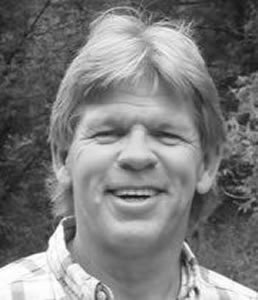
Dear Friends,
It is my honor to welcome you to the 54th season of the Ashland Symphony Orchestra. We look forward to seeing and hearing what our Grammy Award winning Music Director and Conductor, Michael Repper, in his second year, has in store for us. Michael’s enthusiasm, talent, and ability to “think outside the box” in dynamic, innovative, and delightful ways were evident in his inaugural year. He and our outstanding musicians presented an array of both familiar and new musical offerings and we look forward to more of that this year. As always, we strive to unite, educate and enrich our community through the engaging and transformative power of orchestral music experiences. We hope you find it inspiring and refreshing. Happy listening!
Music Director's Message
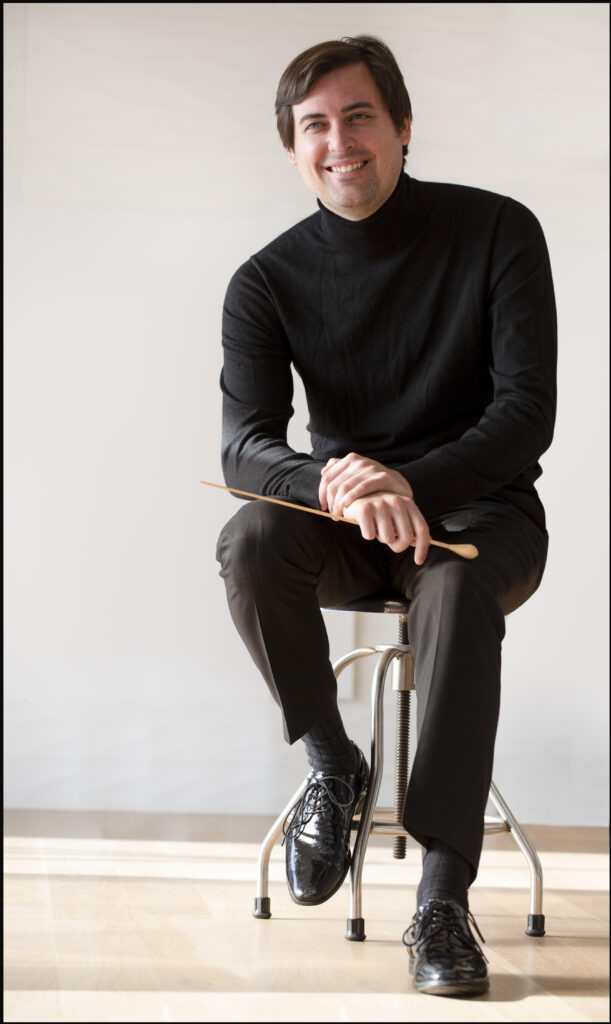
Dear Ashland Symphony Orchestra Patrons,
It is my great privilege to welcome you to our concerts at the marvelous Robert M. & Janet L. Archer Auditorium. I am incredibly proud to be taking the helm as Ashland’s new Music Director, and to continue to grow this jewel of Ashland County. We are going to make tremendous music together and enjoy a wonderful communal spirit. Our concerts are a place for everyone – come and enjoy, and be sure to introduce yourself! Our musicians and I are incredibly proud to share our work with you, and we hope you enjoy every minute!
Michael Repper
Music Director and Conductor
Ashland Symphony Orchestra
Executive Director's Message
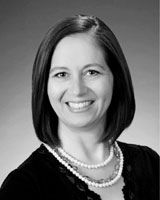
I am excited to be celebrating my 10th season with the ASO! This “Fabulously (un)familiar” season will bring you works by the old masters: Beethoven, Brahms, Mozart, and Tchaikovsky. But you will also hear the world premiere of Stefan Swanson’s Symphony No.2 “Lipsky”, Iubilo by Brian Nabors, Starburst by Jessie Montgomery, and the artistry of the young cellist Aurelia Faidley-Solars, just to name a few of the unfamiliar musical experiences you will have.
Free tickets for children and students and the ASO Fan Club, for students in 9th-12th grade and college students, and the new ASO Fan Club Jr, for students in 4th-8th grade, bring young listeners to our concerts.
Be sure to invite your friends, family, and colleagues to come listen to what people are talking about!
Martha Buckner
Executive Director
Ashland Symphony Orchestra
Music Director & Conductor
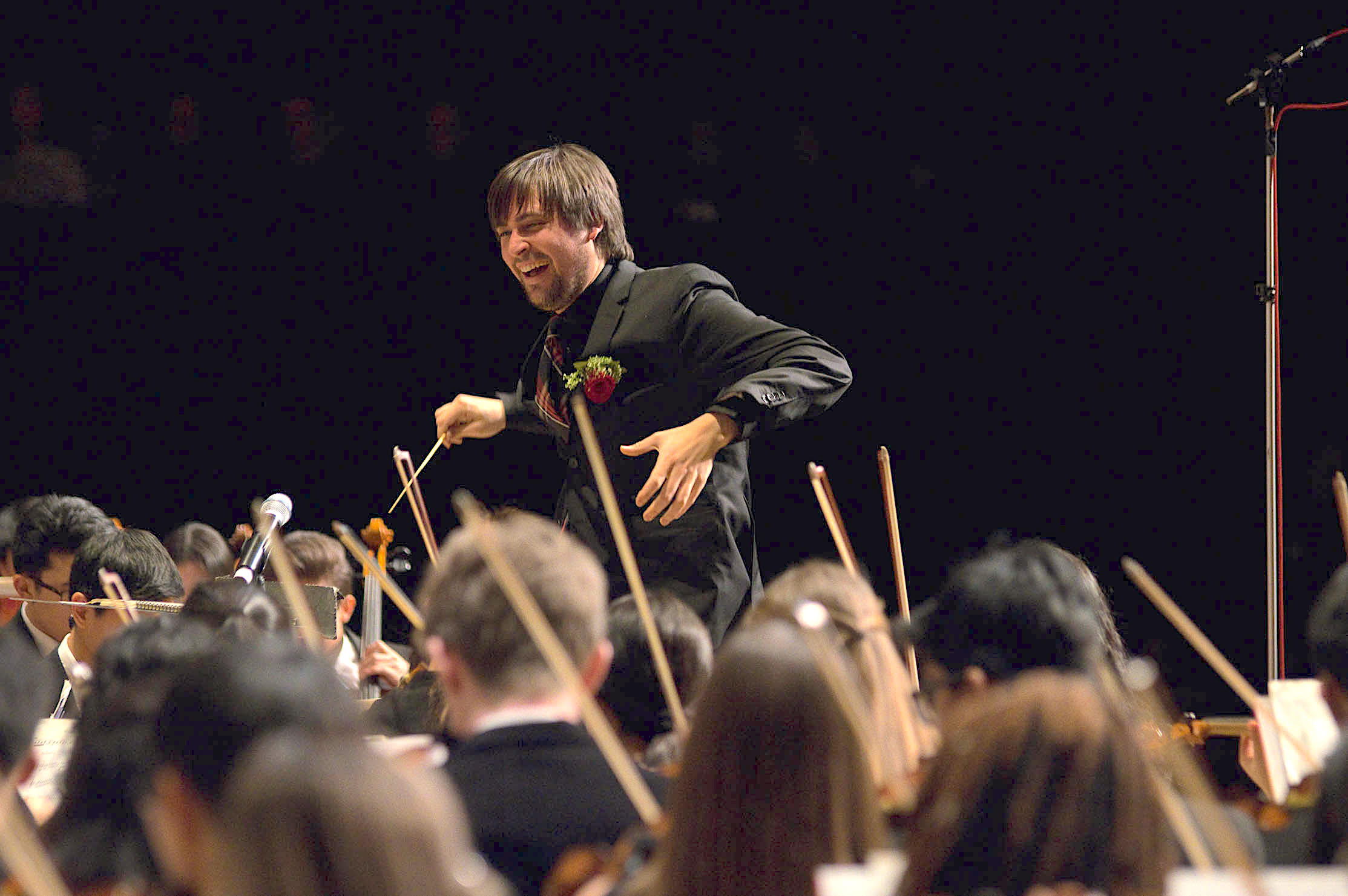
Michael Repper is one of the most sought-after young conductors in the world. With work spanning four continents, Mr. Repper has an international reputation for engaging and exciting audiences of all spectrums, and for promoting new and diverse musical talents. In 2023, he became the youngest American conductor to win a Grammy® Award in Best Orchestral Performance.
Mr. Repper is the Music Director of the Ashland Symphony Orchestra, Mid-Atlantic Symphony Orchestra, New York Youth Symphony, Northern Neck Orchestra of Virginia, and the Principal Conductor of Sinfona por el Peru, the elite youth orchestras and choruses representing one of South America’s most versatile social impact music programs. Recognizing his success at these ensembles, and his growing profile as a guest conductor all over the world, Mr. Repper was awarded a Solti Foundation US Career Assistance Award in 2020, 2021, and 2022.
His album with the New York Youth Symphony, which features debut recordings of works by Florence Price, Jessie Montgomery, and Valerie Coleman, achieved widespread critical acclaim, reached #1 on the Billboard Chart, a won a GRAMMY® Award, the first youth orchestra to achieve this milestone.
Mr. Repper has collaborated on large-scale productions of symphonic and theatrical works with the Weill Music Institute at Carnegie Hall, the Chicago Symphony Orchestra, Ravinia Festival, Peabody Institute of Music, and the New School of Music, among others. An avid pianist, he regularly performs as a soloist alongside his orchestras and choruses, and as an orchestral player as well. Most recently, he played in the Chicago Symphony for their performances of Bernstein’s Mass, which was broadcast on PBS Great Performances.
Alongside the standard repertoire, Mr. Repper is especially invested in programming new music and showcasing fresh talent. His ensembles have performed dozens of world premieres and pursued innovative commissions, as well as a variety of Carnegie Hall premieres from established and emerging composers. Mr. Repper was the Baltimore Symphony Orchestra Conducting Fellow for two seasons, and he served as the BSO’s New Music Consultant. A trusted ear, Mr. Repper is asked to assist and cover at orchestras nationwide, including the St. Louis Symphony, and for Naxos recordings with the Peabody Symphony Orchestra. His experience with choruses has been recognized with significant positions, including his tenure as the Music Director at the Baltimore Basilica, the first Catholic Cathedral in the United States. Internationally, Mr. Repper has performed with some of the most highly regarded ensembles and in the world’s greatest venues, including the Sao Paulo Symphony, and at the Palau de la Musica in Barcelona.
His discography includes the aforementioned album of music with the New York Youth Symphony, alongside an album with the Grammy-Nominated Metropolis Ensemble and Grammy-Winning Brooklyn Youth Chorus (“Musical America”), and several with the Peabody Institute as an Assistant Conductor. With the New York Youth Symphony during the Coronavirus pandemic, he was one of the first to pioneer the practice of distanced orchestral performance videos, and he made two performance appearances on CNN, the final one with Platinum-Artist Billy Ray Cyrus.
Mr. Repper complements his work with professional orchestras with a firm commitment to education, and travels worldwide to work with ensembles of young musicians. As Artistic Director of the Chamber Music Society of Maryland, he ushered in a slate of innovative educational programming, such as the Reinecke Youth Chamber Music Scholarship and Fellowship Program. He conducts several masterclasses each year for orchestras from all over the United States on behalf of the New York Philharmonic, and conducts side-by-side and educational concerts with major orchestras, including the Baltimore Symphony and the Colorado Symphony.
Mr. Repper’s most influential conducting mentors are Marin Alsop and the late Gustav Meier. He believes that a conductor’s main role is to connect people and to use performance as a vehicle for positive change. He aims to promote a diverse and inclusive future for the arts, and to pay forward the passion for community that his mentors demonstrated to him.
Program Notes: MONTGOMERY
Program Notes: TCHAIKOVSKY
Soloist Aurelia Faidley-Solars
 A leading young artist of her time, Aurelia Faidley-Solars has been heralded by the New York Classical Review as “a wonderfully gifted 12-year-old with remarkable technique and a musical understanding beyond her years.” At the age of four, frustrated by having been made to play the violin, she took a child-sized violin, placed it between her knees, and exclaimed to her parents that she wanted a cello for her birthday, and it was then that her career as a cellist began.
At age 11, she made her solo debut with the Amati Orchestra in Lausanne, Switzerland. Since then, she has performed with the Sempre Musick Symphony (Boston), the Metropolitan Symphony of New York, the Blue Ash Montgomery Symphony, the New Jersey Sinfonietta, and the New York Concerti Sinfonietta. She has performed in recitals in New York, Prague, Budapest, Vienna, Barcelona, and London.
Aurelia studies currently at the Juilliard Pre-College Division under Fred Sherry. Her other teachers have included Hans Jorgen Jensen and Natasha Brofsky. She has appeared in masterclasses with Laurence Lesser, Richard Aaron, Darrett Adkins, Brannon Cho, Phillipe Muller, David Finckel, Ralph Kirschbaum, Amit Peled, Stephen Doane, Rosemary Elliot, Peter Stumpf, Jean-Michel Fonteneau, Fred Sherry, Clive Greensmith, and Pablo Ferrandez.
Aurelia is an accomplished prize winner in numerous competitions. This includes the Fox Valley Concerto Competition, the Ambler Symphony Concerto Competition, the Hill Concerto Competition, the Sound Symphony Concerto Competition, the Vienna International Music Competition, the CelloWorld Concerto Competition, the Petrichor Competition, the Birmingham International Competition. She is the youngest prizewinner in the history of The Ronald Sachs International Competition, as well as the two-time New Eastern regionals winner for the Music Teachers’ National Association. She was also awarded the prestigious Aaron Rosand Memorial Prize and is the 2023 Menges Scholarship recipient. Aurelia is the youngest finalist in the history for the Artist Presentation Society and was the only student featured in a solo performance celebrating the 130th Anniversary of the New World Symphony, a joint project between the United States and The Czech Republic. Aurelia was the 2023 soloist chosen for the “Young Artists Performers” series in South Carolina and has toured throughout the northeastern and southeastern United States.
At age 12, Aurelia released her first album “From Bach to Summerland, receiving praise from reviewers. Her second album will feature the Elgar Cello Concerto in E Minor, due out on Petrichor Records in the summer of 2023.
Aside from the cello, Aurelia is a dedicated ballet dancer, studying in the Pre-Professional division at the School of American Ballet. She has performed numerous times in featured roles in the New York City Ballet’s “The Nutcracker” and as a consequence, can be seen in the Disney Plus documentary series On Pointe. She has also performed in the New York City Ballet’s production of “A Midsummer’s Night Dream”. In 2023, she attended the Royal Ballet School’s Summer Intensive Program in London.
Composer Stefan Swanson

Professional
Stefan Swanson is an award-winning composer for film, media, and concert, with over a decade of film scoring experience and over fifty scoring credits. He has also enjoyed tremendous success composing for the concert hall with over sixty compositions ranging from solo instruments to full orchestra, including River Thoughts, his first symphony. His music has been heard all over the world including Lincoln Center, Cannes, Aspen, along with broadcasts on HBO, Cinemax, NBC, and BET.
In 2011, the award-winning dramatic feature film GUN HILL ROAD, starring Esai Morales (NYPD Blue, La Bamba) and Judy Reyes (Scrubs, Hawthorne), along with Swanson’s score, enjoyed tremendous success at the Sundance Film Festival and later was released in theaters worldwide (Motion Film Group). Over the years Swanson’s scores for the award-winning dramas STONE CARS, PREMATURE and CUTS, have aired on HBO, Cinemax, and BET. Currently you can find ESCAPING FED and HARD LAUGHTER streaming on Amazon.
His recent commissions include ARIA AND ALLEGRO FOR BASS TROMBONE AND PIANO for bass trombonist JJ Cooper, and THE WIND, commissioned and premiered by the Harmonium Choral Society under the direction of Anne Matlack.
Education
Stefan holds a PhD in music composition at Rutgers University where he studied with Charles Fussell. He earned his Masters degree at New York University’s scoring for film and multimedia program where he studied composition with Ira Newborn (FERRIS BUELLER’S DAY OFF, NAKED GUN, ACE VENTURA: PET DETECTIVE).
In the spring of 2007 he received the Scholarship from the Film Music Museum in Los Angeles to attend the NYU/ASCAP Foundation Film Scoring Workshop in Memory of Buddy Baker. While there he received instruction from Mark Snow (THE X-FILES, SMALLVILLE), orchestrator Sonny Kompanek (THE GOOD SHEPHERD, HOLLYWOODLAND), and music editor Tim Starnes (LORD OF THE RINGS trilogy).
The following summer, Stefan attended the Aspen Summer Music Festival for a third time, where he received the Susan and Ford Schumann Scholarship. There he studied film scoring with Academy Award nominated composer Bruce Broughton (SILVERADO, TOMBSTONE) and Jeff Rona (HOMOCIDE: LIFE ON THE STREET, WHITE SQUALL).
Other
Stefan is also an experienced conductor (both concert and film), orchestrator, arranger, and producer. He conducted and co-orchestrated Ron Sadoff’s score to the critcally acclaimed documentary CHUCK JONES: MEMORIES OF CHILDHOOD (Gladeyes Films) which premiered on Turner Classic Movies. He also conducted the Manhattan Camerata at the Consulate General of Argentina in New York City (March 10, 2010). He worked with the tremendously successful sample library company Embertones and you can hear his work on their website. You can also hear his arrangement of the Ron Sadoff/Ira Newborn theme for NYU Doctor Radio on Sirius Satellite Radio.
Maestro Arie Lipsky

Born in Israel where he received extensive training as a cellist and as a flutist, Arie Lipsky was just nine when he won the first of many prestigious musical competitions allowing him to solo with his town’s orchestra. After this impressive success, he began to appear in concerts throughout Israel and Europe. Mr. Lipsky subsequently began serious study of composition and conducting. His mentors include Semyon Bychkov, Yoel Levi and Kurt Mazur in conducting and Pablo Casals and Leonard Rose on cello.
He holds degrees in Aeronautical Engineering and Music which he received before serving in the Israeli Army.
After moving to the United States, Mr. Lipsky served as Assistant Conductor of the Cleveland Institute of Music and the Ohio Opera. He moved to Buffalo in 1984 to become the Buffalo Philharmonic’s principal cellist and in 1990, he became its Resident Conductor. In early 1995, on short notice, Arie replaced the late Eduardo Mata conducting the Israel Chamber Orchestra, where his success resulted in return engagements with many of Israel’s leading orchestras. Lipsky served as Music Director of the Ann Arbor Symphony Orchestra and the Ashland Symphony Orchestra and has conducted major orchestras in the United States, Israel, Canada, Europe and South Korea.
An elegant and expressive conductor, Lipsky garners high praise from some of the world’s best conductors. Semyon Bychkov, former Music Director of Orchestre de Paris, calls Mr. Lipsky. . . a born conductor, and Yoel Levi, former Music Director of the Atlanta Symphony Orchestra, says that As a musician Arie is first class; his technique is excellent, his memory outstanding . . . he knows how to communicate and is well deserving of respect and admiration.
Lipsky grew a tremendous and loyal audience in Southeastern Michigan with concerts where both discerning and casual listeners alike praised what was known as an Ann Arbor Symphony sound of confidence and clarity. As one reviewer said, under the baton of Music Director Lipsky, the Orchestra played with finesse and polish that experience brings to bear. Under his baton the Ashland Symphony Orchestra has been known as “The Jewel of Ashland County.”
The Ann Arbor Symphony Orchestra released its first CD under the direction of Maestro Lipsky on the NAXOS label in 2009. Mr. Lipsky also has recorded on the Fleur de Son Classics label. His CD, New Arts Trio in Recital at Chautauqua was reviewed by Fanfare Magazine: affirm that this is one of the most interesting and exciting discs of piano trios, or any chamber music, or any classical music I have ever heard. Other critically acclaimed CD recordings include Schubert Overtures and Concertos by Sierra and Bruch and Guitar Concerti with the Castellani-Andriaccio Duo and the Israel Chamber Orchestra. Arie was also a member of the New Arts Trio in residence at the Chautauqua Institute, where he served as Director of Chamber Music.
Arie now resides in Israel, plays chamber music and guest conducts Symphony Orchestras around Israel. He also teaches online young musicians in Israel, Europe and the US how to prepare auditions with professional orchestras.
ASO Musicians
Other Info
Sponsors


Donor List
Endowments